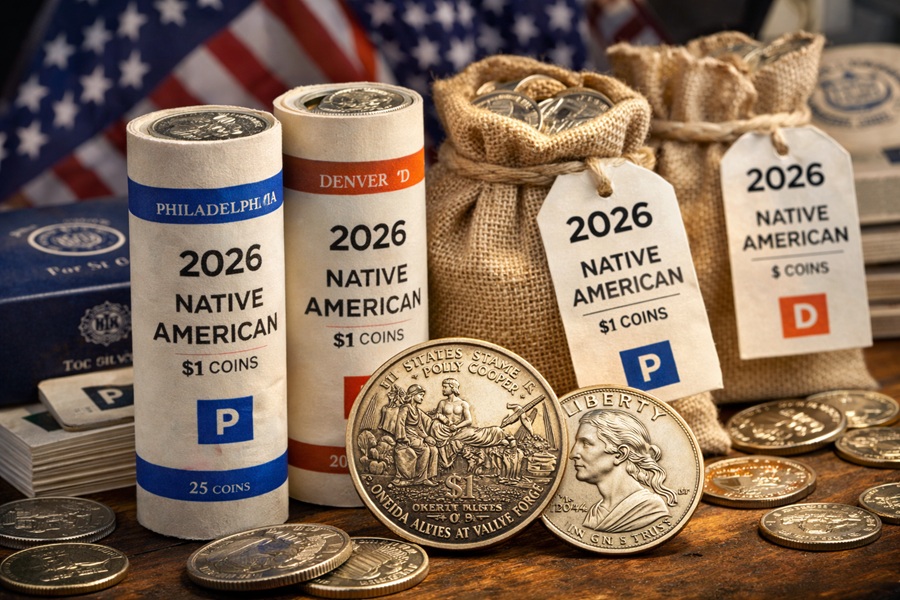
When the U.S. Mint releases a new Native American $1 Coin, seasoned collectors know they’re not just buying a dollar — they’re acquiring a piece of American history told through modern numismatics.
The 2026 Native American $1 Coin officially launches in rolls and bags, continuing a program that has quietly become one of the most historically meaningful and educational series produced by the United States Mint. This year’s reverse honors the Oneida Tribe and their critical assistance to General George Washington’s Continental Army during the harsh winter at Valley Forge — a story many Americans learned in textbooks, but few associate with Native American contributions.
For coin collectors in the U.S., numismatists, coin investors, and industry professionals, this release is more than another annual issue. It reflects evolving collector demand, pricing shifts, and long-term mintage trends that directly affect valuation potential.
Let’s take a closer look at what makes the 2026 issue significant — historically, artistically, and from a market perspective.
The 2026 Native American $1 Coin Design: Honoring the Oneida Tribe
The reverse (tails side) of the 2026 Native American $1 Coin depicts a powerful and historically grounded scene: Oneida woman Polly Cooper presenting corn to General George Washington at Valley Forge. Washington is shown holding his hat in gratitude — a subtle but meaningful symbol of respect.
The design was:
- Created by Artistic Infusion Program artist Beth Zaiken
- Sculpted by U.S. Mint Medallic Artist Craig Campbell
- Selected after review by the Citizens Coinage Advisory Committee (CCAC) and the Commission of Fine Arts (CFA)
Inscriptions include:
- UNITED STATES OF AMERICA
- POLLY COOPER
- ONEIDA ALLIES AT VALLEY FORGE
- $1
The obverse retains Glenna Goodacre’s iconic Sacagawea portrait with her infant son Jean Baptiste — unchanged since the program’s inception in 2009.
Unlike many 2026 issues, this dollar does not include semiquincentennial (250th anniversary) markings, a noteworthy detail for collectors tracking thematic continuity.
Why This Theme Matters Now
As the United States approaches its 250th anniversary, interest in Revolutionary War-era subjects is increasing across collecting categories. By highlighting the Oneida Tribe’s role at Valley Forge, the Mint expands the narrative beyond traditional figures.
From an educational standpoint, the program aligns with Congress’s mandate under Public Law 110-82 to recognize Native American contributions annually.
For collectors, this continuity strengthens the long-term integrity of the Native American Dollar Program.
2026 Native American $1 Coin Specifications
For those focused on technical and valuation aspects, here are the official specifications:
- Denomination: $1
- Composition: 6% Zinc, 3.5% Manganese, 2% Nickel, Balance Copper
- Weight: 8.100 grams
- Diameter: 1.043 inches (26.49 mm)
- Edge: Lettered (Year, Mint Mark, E PLURIBUS UNUM)
- Mint Marks: P (Philadelphia), D (Denver)
The edge-lettering feature remains a defining characteristic of modern U.S. dollar coins and an area of specialization for error collectors.
Rolls and Bags: Pricing and Product Limits
The U.S. Mint offers the Native American $1 Coin rolls and bags in the following configurations:
| Product Option | Product Limit | Household Order Limit | Price |
|---|---|---|---|
| 25-Coin Roll – P | 14,700 | None | $61 |
| 25-Coin Roll – D | 14,700 | None | $61 |
| 100-Coin Bag – P | 1,800 | 10 | $154.50 |
| 100-Coin Bag – D | 1,800 | 10 | $154.50 |
Pricing Analysis
Notably, pricing has increased significantly from last year’s introductory levels:
- 2025 Rolls: $36.25
- 2025 Bags: $123.50
This year’s $61 roll price represents a substantial jump.
Why the increase?
While the coins themselves contain no precious metal, the Mint factors in:
- Production costs
- Distribution and packaging
- Numismatic premium structure
- Program sustainability
Industry analysts have noted that higher roll premiums may slow speculative bulk buying compared to earlier years.
Native American Dollar Mintages: A Dramatic Shift Since 2012
One of the most important market dynamics affecting the U.S. Mint Native American Dollar is its shift from circulation to numismatic-only production.
From 2009–2011, mintages exceeded 70 million annually. In 2012, circulating production ended.
Here’s what followed:
- 2013–2021: Mintages fell between 2.5M–5M annually
- 2022: Dropped to 1.96M total
- 2025: Rose again to 5.18M
This shift has several implications:
1. Reduced Availability in the Wild
Collectors rarely encounter these coins in circulation, increasing reliance on Mint purchases.
2. Controlled Supply
Lower mintages can enhance long-term collectibility, though not necessarily short-term price appreciation.
3. Secondary Market Stability
Modern Native American dollars typically trade modestly above issue price in original packaging unless tied to errors or high-grade registry demand.
According to Professional Coin Grading Service (PCGS) population data, high-grade MS67+ examples from lower mintage years often command premiums, though the series remains accessible overall.
Investment vs. Collection: Is the 2026 Native American $1 Coin a Smart Buy?
Pros
- Strong historical narrative
- Limited product caps
- Long-running, cohesive series
- Affordable entry point for new collectors
Cons
- No precious metal content
- Historically modest secondary market appreciation
- Higher 2026 pricing may compress upside
From an investment standpoint, these coins should not be viewed as bullion alternatives. Their value is primarily numismatic.
As veteran dealer commentary often suggests: “Buy Native American dollars for the story and the series continuity — not for quick profit.”
That said, long-term registry collectors and thematic historians often maintain steady demand for complete roll sets.
Comparing Early and Modern Native American Dollar Production
| Era | Annual Mintages | Distribution |
|---|---|---|
| 2009–2011 | 70M–80M+ | Circulation & numismatic |
| 2012 | 5.88M | Transition year |
| 2013–Present | 2M–5M | Numismatic-only |
The dramatic mintage contraction after 2012 marks one of the most significant supply adjustments in modern U.S. coinage history.
For context, similar production shifts occurred with Presidential Dollars when the Federal Reserve suspended routine circulation distribution in 2011.
Design Review and Artistic Integrity
The involvement of the CCAC and CFA ensures historical vetting and artistic oversight.
Design candidates were introduced publicly in 2024 before final selection — a transparency process that has improved over the past two decades.
The Artistic Infusion Program, launched in 2004, continues to diversify creative input into U.S. coinage, elevating modern issues to museum-level art pieces.
Who Should Consider Buying?
The 2026 Native American $1 Coin may appeal to:
- Modern U.S. series collectors
- Native American history enthusiasts
- Revolutionary War thematic collectors
- Registry set participants
- Educators and historical institutions
It may be less suitable for:
- Pure precious metals investors
- Short-term speculators
- Buyers seeking rapid secondary market gains
TL;DR
- The 2026 Native American $1 Coin honors the Oneida Tribe’s support at Valley Forge.
- Available in rolls and bags from the Philadelphia and Denver Mints.
- Pricing is significantly higher than last year.
- Mintages remain relatively low compared to early program years.
- Best suited for collectors focused on history and series completion rather than bullion investment.
FAQ
Are 2026 Native American $1 Coins released into circulation?
No. Since 2012, they have been produced primarily for numismatic sale.
Do these coins contain silver or gold?
No. They are manganese-brass clad coins with no precious metal content.
Are lower mintages likely for 2026?
Final mintages depend on total sales. Product caps suggest controlled distribution.
Can these coins appreciate in value?
Historically, appreciation has been modest, though high-grade certified examples can command premiums.
What makes this year’s design unique?
It highlights Polly Cooper and the Oneida Tribe’s role at Valley Forge — a lesser-known but historically vital contribution to the American Revolution.
Conclusion: A Modern Dollar with Historical Weight
The 2026 Native American $1 Coin continues one of the U.S. Mint’s most meaningful long-running programs. While not a precious metals investment vehicle, it stands as a powerful commemorative tribute embedded in everyday American currency design.