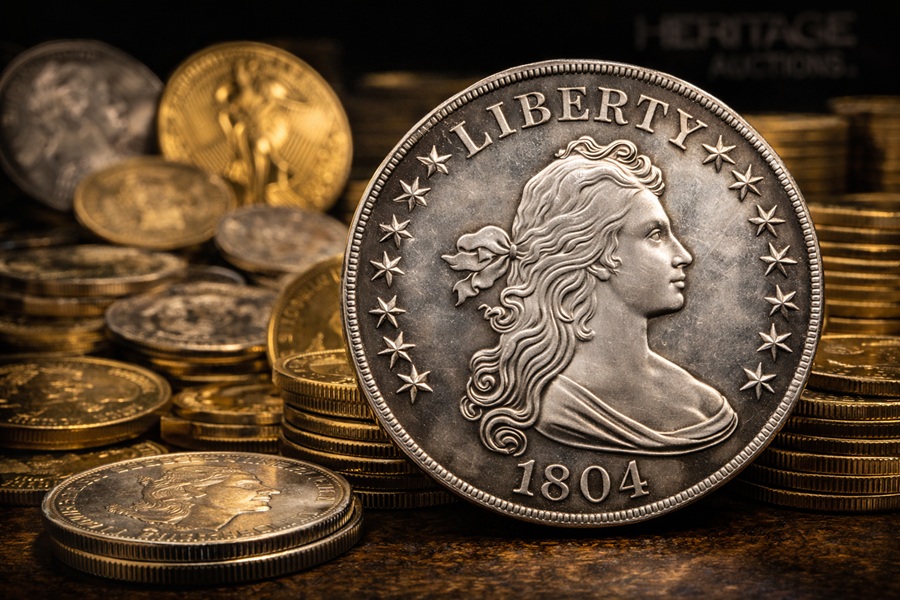
When a coin crosses the auction block for $3.538 million, seasoned collectors take notice. When that coin is an 1804 dollar, the entire numismatic world pauses.
The recent sale of the Adams-Carter Class III 1804 dollar at the Heritage Auctions FUN U.S. Coins Signature Auction once again underscores why this legendary issue has long been called the “King of United States Coins.” In a hobby defined by rarity, provenance, and historical mystique, the 1804 dollar sits at the very summit.
For U.S. coin collectors, numismatists, industry professionals, and coin investors alike, this sale is more than a headline—it’s a powerful reminder of how elite rarities continue to perform in today’s market.
Let’s explore why.
The 1804 Dollar: The King of United States Coins
The 1804 dollar holds a unique position in American numismatics. Despite the date, no silver dollars were actually struck for circulation in 1804. The coins bearing that date were produced decades later, primarily as diplomatic presentation pieces during the 1830s.
This historical twist is part of what elevates the 1804 dollar from rarity to royalty.
Among experts, the coin’s reputation is well cemented. In multiple editions of 100 Greatest U.S. Coins by Jeff Garrett and Ron Guth, the 1804 dollar has claimed the #1 position more than once—an unprecedented distinction.
As Garrett himself has noted in past commentary, the 1804 dollar combines:
- Extreme rarity
- Diplomatic and political significance
- Documented provenance
- Iconic status among collectors
Few coins check every one of these boxes.
1804 Dollar Sold for $3.538 Million at Heritage Auctions
At the January 2026 FUN U.S. Coins Signature Auction, Heritage Auctions sold the Adams-Carter specimen of the Class III 1804 dollar for $3.538 million.
This result places the coin among the top echelon of multimillion-dollar American coins and earned it a spot in the prestigious Heritage Hall of Fame.
While the $3.538 million price does not approach the $18 million record set by the 1933 double eagle, context matters. The double eagle is unique in private hands. The 1804 dollar exists in just 15 known specimens across all classes, making every offering a landmark event.
In a market that has experienced volatility in certain modern segments, elite trophy coins continue to demonstrate resilience.
Understanding the Class III 1804 Dollar
There are three recognized classifications of 1804 dollars:
- Class I – Original diplomatic presentation pieces (1834–1835)
- Class II – Mint restrikes (unique)
- Class III – Later restrikes produced clandestinely in the late 1850s
The Adams-Carter coin belongs to Class III, often described as “restrikes with edge lettering added after striking.”
Although technically restrikes, Class III examples have long been accepted as legitimate Mint products. In fact, they are among the most coveted rarities in American numismatics.
Why Class III Matters
- Only six Class III examples are known.
- Many have institutional or tightly held ownership.
- The Adams-Carter specimen boasts one of the longest and most distinguished provenances.
Provenance—the documented ownership history of a coin—adds immeasurable prestige in elite circles. In high-end numismatics, a coin’s pedigree can influence value as much as its grade.
Provenance: The Adams-Carter Pedigree
The Adams-Carter 1804 dollar has passed through some of the most prominent collections in American history.
Collectors such as:
- Charles Francis Adams
- Amon Carter Sr.
- Other distinguished numismatists
have stewarded this piece over decades.
In rare coin markets, provenance does three critical things:
- Enhances liquidity
- Reduces authenticity concerns
- Adds historical narrative
As one veteran dealer remarked at FUN, “When you buy an 1804 dollar, you’re not just buying silver—you’re buying two centuries of numismatic history.”
That statement rings particularly true for this specimen.
Comparing the 1804 Dollar to Other Legendary U.S. Coins
To appreciate the 1804 dollar’s status, it helps to compare it with other iconic rarities:
| Coin | Record Price | Known Examples | Unique Factor |
|---|---|---|---|
| 1933 Double Eagle | $18 million | 1 legal private specimen | Legal battle history |
| 1913 Liberty Head Nickel | ~$4–5 million | 5 | Mystery origins |
| 1822 Half Eagle | ~$8.4 million | 3 | Early gold rarity |
| 1804 Dollar | $3.538M (recent) | 15 (all classes) | Diplomatic restrike legend |
Unlike some coins whose value derives primarily from extreme scarcity, the 1804 dollar blends scarcity with mythology and institutional validation.
Market Context: Trophy Coins in 2026
The rare coin market operates in tiers.
- Modern issues often track bullion or registry competition trends.
- Mid-tier rarities fluctuate with broader collector demand.
- Elite trophy coins operate almost as a separate asset class.
In recent years, multimillion-dollar coins have continued attracting:
- Ultra-high-net-worth collectors
- Diversified investors
- Museums and institutions
According to publicly reported auction data from major firms, six- and seven-figure rarities have remained comparatively stable even during broader economic uncertainty.
This sale reinforces a long-standing principle: true trophy coins are less sensitive to short-term economic cycles.
Investment Perspective: Is the 1804 Dollar a Financial Asset?
From a YMYL standpoint, it’s critical to distinguish between historical significance and guaranteed returns.
Strengths
- Extreme rarity
- Global brand recognition
- Deep collector base
- Strong auction track record
Risks
- Illiquidity at price level
- Dependent on elite buyer pool
- Long holding horizon typically required
The 1804 dollar should not be viewed as a speculative flip. Rather, it represents:
- Generational wealth preservation
- Legacy collecting
- Cultural asset ownership
For most collectors, owning an 1804 dollar remains aspirational. However, its performance can positively influence the broader rare coin market by reinforcing confidence in tangible historical assets.
Why the 1804 Dollar Still Ranks #1
The phrase “King of United States Coins” is not marketing hype—it is consensus forged over generations.
The coin’s appeal rests on five pillars:
- Historical intrigue (struck decades after its date)
- Diplomatic origins
- Extremely low survival
- Extensive scholarly research
- Continuous elite collector demand
No other U.S. coin combines these elements so completely.
Even the 1933 double eagle, record-setting as it is, lacks the layered provenance and numismatic tradition attached to the 1804 dollar.
Broader Impact on the Rare Coin Market
High-profile sales create ripple effects.
When an 1804 dollar sells for $3.538 million:
- Registry-level coins see renewed interest.
- Early U.S. type coins gain attention.
- Dealers report increased inquiries for Draped Bust material.
Historically, landmark auction results often precede short-term upticks in related categories.
For industry professionals, this sale serves as a reminder that elite numismatics remains vibrant and globally relevant.
TL;DR
- The Adams-Carter Class III 1804 dollar sold for $3.538 million.
- The 1804 dollar remains known as the “King of United States Coins.”
- Only 15 examples exist across all classes.
- Provenance and historical intrigue drive its value.
- Elite trophy coins continue showing market strength in 2026.
FAQ: 1804 Dollar Auction Insights
How many 1804 dollars exist?
Fifteen examples are known across three classes.
Why were 1804 dollars struck later?
They were produced in the 1830s as diplomatic presentation pieces, using the last year silver dollars had officially been authorized.
Is $3.538 million a record?
No. Some 1804 dollars have sold for more historically, but this remains a top-tier result.
Are Class III examples less desirable?
Not necessarily. While Class I pieces are often preferred, Class III coins remain highly valuable and prestigious.
Should investors consider rare coins like this?
Only experienced, well-capitalized buyers should consider multimillion-dollar rarities, ideally with professional guidance.
Conclusion: A Throne That Remains Secure
The 1804 dollar has reigned for nearly two centuries—not merely because it is rare, but because it embodies the very essence of American numismatics.
Its latest $3.538 million sale confirms what generations of collectors have already known: true greatness in coin collecting transcends metal content and grade. It rests on history, mystique, and legacy.
For serious collectors and industry observers, the message is clear—when the King appears at auction, the market listens.
And in 2026, the King still commands his throne.