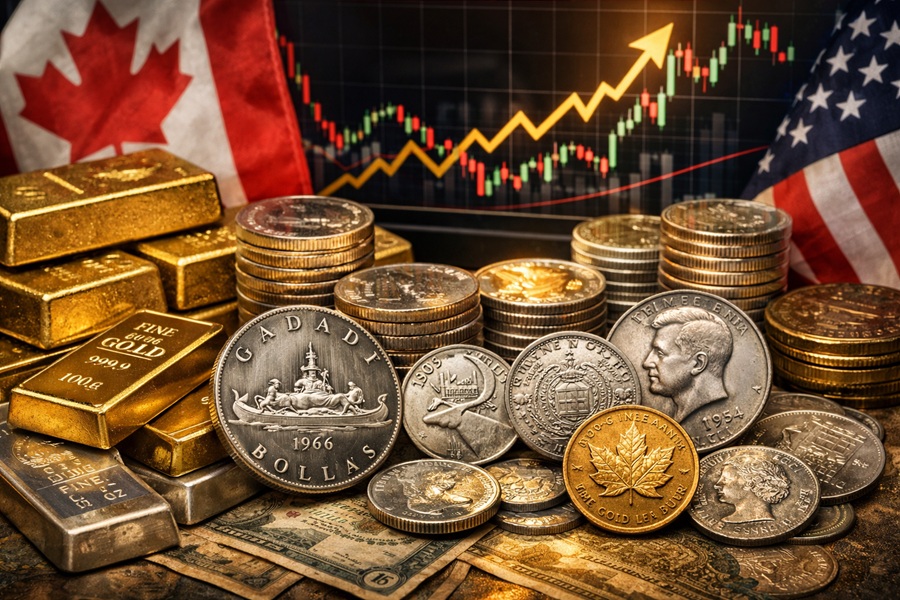
When gold and silver prices surge, the impact is rarely confined to bullion investors. Today’s bullion surge reshaping collectors’ market is sending shockwaves through Canada’s numismatic landscape — and its ripple effects are being felt across North America.
With silver and gold recently touching record highs in Canadian dollar terms, collectors, dealers and investors are navigating one of the most transformative precious metals cycles in decades. According to long-time Winnipeg dealer Ian Laing of Gatewest Coins, political instability, inflation concerns and global economic uncertainty are driving a wave of bullion demand that is permanently altering the coin market.
For U.S. collectors and coin investors watching these developments, the Canadian experience offers both cautionary lessons and potential opportunity.
Why the Bullion Surge Reshaping Collectors’ Market Matters Now
The current rally in gold and silver prices is not happening in isolation. It reflects broader macroeconomic pressures:
- Persistent global inflation concerns
- Central bank gold accumulation at record levels (World Gold Council data shows central banks added over 1,000 tonnes in recent years)
- Heightened geopolitical tensions
- Currency volatility, including a stronger U.S. dollar triggering periodic pullbacks
As Laing notes, buyers — particularly in Asia — are increasingly treating bullion as financial insurance. That shift in investor psychology is critical. When precious metals become a defensive asset class rather than a speculative trade, demand can intensify quickly.
While bullion markets experienced sharp pullbacks during recent U.S. dollar strength, the longer-term trend remains elevated by historical standards. In Canadian dollars, both gold and silver have reached record territory — a dynamic amplified by currency exchange rates.
For coin collectors, this isn’t just a price story. It’s a structural market shift.
The Silver Melt: Disappearing Entry-Level Canadian Coins
Perhaps the most profound consequence of the bullion surge reshaping collectors’ market is the accelerated melting of common-date Canadian silver coins.
For decades, pre-1967 Canadian silver coinage served as an accessible entry point into the hobby. These coins typically carried modest premiums above melt value, making them ideal for:
- Beginning collectors
- Young hobbyists
- Budget-conscious enthusiasts
- Silver stackers entering numismatics
Now, as silver prices climb, many of these coins are being sold for melt.
Melt Value vs. Numismatic Value
When intrinsic metal value exceeds collectible value, the market often rationalizes through melting. This phenomenon is not new — but the scale may be unprecedented in modern Canadian history.
Consequences of widespread silver melt:
- Permanent reduction in supply
- Rising premiums for surviving examples
- Shrinking availability of affordable starter coins
- Greater barrier to entry for new collectors
Over time, this dynamic can reprice entire segments of the market. Coins once considered “common” can become condition rarities simply due to attrition.
For U.S. collectors, this mirrors what happened with pre-1965 U.S. 90% silver coinage during past silver spikes. When melt pressures intensify, numismatic supply contracts.
Lessons from the 1980 Hunt Brothers Silver Spike
No discussion of a silver price surge is complete without revisiting 1980, when the Hunt brothers famously attempted to corner the silver market.
Silver briefly soared to nearly $50 per ounce in January 1980 (roughly equivalent to over $180 in today’s dollars adjusted for inflation). The spike triggered massive melting of circulating silver coinage in both Canada and the United States.
Key differences between 1980 and today:
| 1980 Silver Spike | Current Bullion Surge |
|---|---|
| Speculative concentration | Broad global demand |
| Futures-driven squeeze | Central bank and retail buying |
| Rapid collapse | Structurally supported prices |
| Limited globalization | Highly interconnected markets |
According to market analysts, today’s rally is underpinned by structural factors such as central bank gold purchases and persistent investor distrust of fiat currencies. While volatility remains, the demand base is more diversified than during the Hunt era.
That distinction matters when assessing whether current changes in the Canadian coin market are temporary — or permanent.
Royal Canadian Mint: Struggling to Keep Pace
Another major factor in the bullion surge reshaping collectors’ market is production strain at the Royal Canadian Mint (RCM).
When bullion demand spikes:
- Refining capacity tightens
- Planchet supply chains strain
- Shipping delays increase
- Allocation systems emerge
Similar patterns were observed globally during the COVID-era bullion rush, when the U.S. Mint temporarily struggled to meet American Eagle demand.
The RCM’s inability to immediately scale production exacerbates premiums. Limited supply, paired with intense global demand, creates a classic squeeze.
For modern numismatic issues, rising metal costs also influence pricing. Mint-issued silver and gold collectibles become more expensive at launch, narrowing the margin between bullion value and numismatic premium.
How Rising Precious Metals Demand Impacts Modern Numismatic Issues
The relationship between bullion and modern numismatics is complex.
When metal prices rise:
Pros:
- Increased public interest in coins
- More first-time buyers entering the hobby
- Stronger baseline intrinsic value
Cons:
- Higher retail pricing
- Greater speculative flipping
- Reduced affordability
Modern commemoratives and limited-edition releases from the Royal Canadian Mint often see heightened demand during bullion rallies. However, investors must distinguish between intrinsic value and collectible premium sustainability.
As industry professionals frequently note, “Bullion supports the floor; rarity supports the ceiling.”
In other words:
- Metal value protects downside risk.
- True numismatic scarcity drives long-term appreciation.
Opportunities for Collectors and Investors
Despite supply pressures, there are still strategic opportunities in a bullion-driven market.
1. High-Grade Survivors of Melted Series
As common-date coins disappear, premium-condition survivors may see upward repricing.
2. Underappreciated Semi-Numismatic Bullion
Government-issued bullion coins with limited mintages often outperform generic rounds.
3. Key-Date Canadian Silver Coinage
Key dates are less likely to be melted and may benefit from increased attention to the series.
4. Cross-Border Arbitrage
For U.S. collectors, currency fluctuations may create buying opportunities in Canadian markets.
Risks and Cautions in a Bullion-Driven Coin Market
No market surge is without risk.
Potential downsides include:
- Short-term volatility triggered by U.S. dollar strength
- Overpaying inflated premiums
- Confusing melt-driven price increases with sustainable numismatic growth
- Liquidity constraints if demand cools
It’s worth remembering that gold and silver both experienced sharp pullbacks during past cycles. While long-term demand trends may be favorable, timing matters — especially for investors.
Numismatic professionals consistently advise diversification. Bullion can complement a collection, but historical rarity and condition remain the cornerstones of true numismatic investing.
Market Psychology: Precious Metals as Insurance
A defining theme of this bullion surge reshaping collectors’ market is psychology.
Gold and silver are increasingly viewed not merely as commodities but as financial insurance policies. During periods of geopolitical stress, demand spikes rapidly.
World Gold Council data indicates central banks have been accumulating gold at one of the fastest paces in modern history. That institutional participation lends structural credibility to elevated price levels.
For collectors, this environment reinforces a critical truth:
Bullion and numismatics are intertwined — but not identical.
What U.S. Collectors Should Watch
Although the current spotlight is on the Canadian coin market, similar pressures could affect U.S. coinage if silver prices climb further.
Key indicators to monitor:
- Silver price above melt thresholds for common U.S. 90% coinage
- U.S. Mint production backlogs
- Rising junk silver premiums
- Increased melting activity
History suggests that once coins are melted, they rarely reappear. Supply destruction is permanent.
TL;DR
- Record gold and silver prices are reshaping the Canadian coin market.
- Common-date Canadian silver coins are being melted at accelerating rates.
- The Royal Canadian Mint faces production challenges amid global demand.
- Lessons from the 1980 silver spike offer context — but today’s market is structurally different.
- Collectors must balance bullion exposure with true numismatic rarity.
FAQ
1. Why are Canadian silver coins being melted now?
Because rising silver prices have pushed melt value above collectible premiums for many common-date coins.
2. Is this similar to the 1980 silver spike?
There are parallels, but today’s demand is broader and more globally diversified.
3. Are modern Royal Canadian Mint issues a good investment?
Some limited-mintage pieces perform well, but buyers should evaluate rarity and long-term demand, not just metal content.
4. Could U.S. silver coins face similar melting pressure?
Yes, if silver prices rise significantly above current melt thresholds.
5. Does higher bullion mean all coins will increase in value?
No. Metal value may rise, but numismatic premiums depend on rarity, condition and collector demand.
Conclusion: Adaptation Is the New Strategy
The current bullion surge reshaping collectors’ market is more than a price rally — it is a structural shift with lasting implications for supply, pricing and accessibility.
For coin collectors in the U.S., numismatists, industry professionals and investors alike, the key takeaway is adaptation. Markets evolve. Supply contracts. Premiums adjust.
Those who understand the difference between melt value and collectible value — and who remain disciplined amid volatility — will be best positioned to navigate the next chapter in precious metals and numismatics.