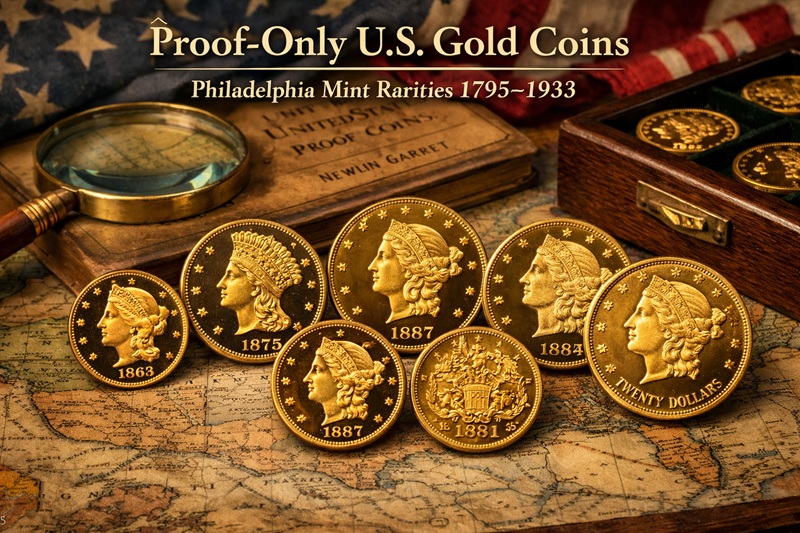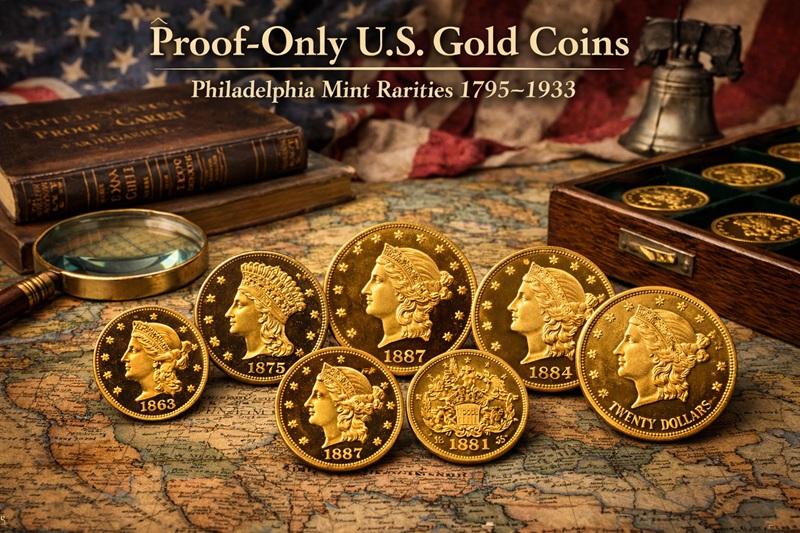
In American numismatics, true rarity is not defined by marketing language or conditional scarcity—it is defined by mintage and survival. That’s why Proof-Only U.S. Gold Coins occupy such rarefied air. Between 1795 and 1933, the Philadelphia Mint produced just seven gold issues struck exclusively in Proof format—coins never released for circulation, minted solely for collectors.
For U.S. coin collectors, investors, and numismatic professionals, these seven coins represent the pinnacle of 19th-century gold collecting. They are structurally rare, historically significant, and consistently coveted at auction.
In today’s market—where six- and seven-figure trophy coins regularly anchor major sales—understanding these issues is more relevant than ever.
What Makes Proof-Only U.S. Gold Coins So Important?
Unlike standard Proof coins struck alongside business strikes, these issues had no circulation counterparts. If you wanted the date, you needed the Proof.
The seven coins are:
- 1863 $2.50 Quarter Eagle
- 1875 $3.00 Gold Piece
- 1876 $3.00 Gold Piece
- 1887 $5.00 Half Eagle
- 1883 $20.00 Double Eagle
- 1884 $20.00 Double Eagle
- 1887 $20.00 Double Eagle
Each is now universally recognized as a major rarity within its series.
The 1863 Quarter Eagle Proof: Civil War Rarity at Its Finest
A Headliner Among Proof-Only U.S. Gold Coins
Struck in the midst of the Civil War, the 1863 $2.50 Liberty Head Quarter Eagle stands as one of the most celebrated Proof gold coins of the 19th century.
- Original mintage: 30
- Estimated survivors: 16–18
Many unsold Proofs were routinely melted, a common Mint practice of the era.
The coin’s stature is reinforced by its inclusion in 100 Greatest U.S. Coins by Jeff Garrett and Ron Guth. Early numismatist Harold P. Newlin described it as the rarest in the quarter eagle series—a statement that still resonates today.
Market Case Study
At the 2022 FUN Convention sale conducted by Heritage Auctions, a PCGS PR66 Deep Cameo CAC example realized $432,000—more than doubling the prior record.
Balanced Market Perspective
Strengths:
- Extremely low survival
- Broad name recognition
- High-grade availability compared to some earlier gold rarities
Risks:
- Limited buyer pool
- Competition from the 1854-S quarter eagle for “trophy” status
For advanced collectors, however, the 1863 remains foundational.
The 1875 and 1876 Three Dollar Gold Pieces
Mint Records vs. Population Reports
Mint records indicate:
- 1875: 20 Proofs
- 1876: 45 Proofs
However, certification data from Professional Coin Grading Service (PCGS) shows higher totals due to:
- Same-year additional strikings
- Resubmissions inflating population figures
Most specialists estimate:
- 1875 actual mintage: 35–40
- 1876 actual mintage: 65–75
This makes the 1876 the most available Proof Three before 1882.
Historical Context
The Three Dollar gold denomination was introduced in 1854 but struggled commercially. By the mid-1870s, circulation demand had nearly evaporated. Production shifted almost entirely toward collector demand.
In 1973, an 1875 Proof $3 gold became the first U.S. gold coin to surpass $100,000 publicly—an inflection point for the high-end rare coin market.
Comparative Investment Outlook
| Issue | Est. Survivors | Market Reputation | Value Trend |
|---|---|---|---|
| 1875 $3 | 20–25 | Prestige leader | Stable |
| 1876 $3 | 40+ | Relative value play | Moderate |
While earlier Proof Threes (1854–1857) have appreciated strongly in recent years, the 1875 retains historical cachet.
The 1887 Half Eagle: The Only Proof-Only Half Eagle
The 1887 $5 Liberty Head Half Eagle remains unique—the only half eagle of any design struck solely in Proof.
- Mintage: 87
- Estimated survivors: ~35
Interestingly, many examples circulated or were cleaned, indicating that the issue was not immediately recognized as a rarity.
Why No Business Strikes?
The late 1880s were marked by intense monetary debate between gold and silver interests. While San Francisco produced substantial gold coinage, Philadelphia’s production patterns reflected shifting Treasury priorities.
The absence of business-strike double eagles in 1887 further underscores this policy shift.
Market Analysis
- No clearly defined “finest known” example
- True Deep Cameo pieces are scarce
- Price spreads between grades are aggressive
Despite this, the 1887 half eagle does not appear grossly overvalued relative to other Proof gold coins from the 1880s.
Proof-Only Double Eagles: The “Triplets”
The Most Recognized Proof-Only U.S. Gold Coins
The 1883, 1884, and 1887 double eagles—often called the “Triplets”—are among the best-known Proof-only gold issues.
All are Type III Liberty Head double eagles, refined by Chief Engraver William Barber.
Mintages:
- 1883: 92
- 1884: 71
- 1887: 121
Earlier Proof double eagles often had lower mintages (20–36 coins), but these three are distinguished by being exclusively Proof.
1883 Double Eagle
- Estimated survivors: 30–35
- Many well-preserved examples
- Strong registry-set demand
Though not the lowest mintage, its survival rate suggests weak contemporary collector demand.
1884 Double Eagle
- Estimated survivors: 15–20
- Several impaired
- Extreme condition rarity in Gem Deep Cameo
The 1884 is arguably the rarest of the Triplets by survival. Competition for premium examples is intense.
1887 Double Eagle
- Estimated survivors: 30–40
- Highest mintage of the three
The fully spelled denomination “TWENTY DOLLARS” reflects the mature Type III design.
High-grade examples represent both absolute and condition rarity.
Why Proof-Only U.S. Gold Coins Matter in Today’s Market
1. Structural Rarity
Every issue discussed has fewer than 50 surviving examples.
In an era when many “rarities” have populations in the hundreds, this distinction matters.
2. Auction Liquidity
These coins consistently headline major sales at:
- FUN Convention
- ANA World’s Fair of Money
- Elite collection dispersals
They attract cross-category demand from:
- Liberty Head specialists
- Type collectors
- Registry-set competitors
- Trophy-level investors
3. Wealth Cycle Sensitivity
High-end U.S. gold rarities often correlate with broader wealth cycles. While demand can soften during economic contraction, long-term performance for historically important coins has been resilient.
Risks and Considerations for Investors
While elite rarities offer prestige, they are not immune to risk.
Key considerations:
- Small buyer pool
- Grade sensitivity (PR64 vs. PR65 can mean six-figure swings)
- Population inflation from resubmissions
- Macroeconomic volatility
Due diligence, third-party grading, and CAC verification remain essential.
TL;DR
- Only seven Proof-Only U.S. Gold Coins were struck at Philadelphia between 1795–1933.
- Survival estimates for each issue are extremely low.
- The 1863 Quarter Eagle and 1884 Double Eagle are among the most coveted.
- Demand remains strong among advanced collectors and investors.
- These coins represent structural, not conditional, rarity.
Frequently Asked Questions
What is the rarest Proof-only U.S. gold coin?
By survival estimates, the 1884 $20 Double Eagle likely has the fewest surviving examples.
Are Proof-only U.S. gold coins good investments?
They can be suitable for long-term collectors and advanced investors, but liquidity depends on grade, eye appeal, and market timing.
Why were unsold Proofs melted?
During the 19th century, the Mint routinely melted unsold inventory rather than store excess coins.
How many collectors own all seven?
Very few. Completing the set is considered one of the most difficult achievements in American numismatics.
Conclusion: The Ultimate Challenge in American Gold Collecting
Assembling all seven Proof-Only U.S. Gold Coins is one of the most demanding and rewarding pursuits in U.S. numismatics. These coins were never intended for commerce. They were struck for collectors—and history determined how few would survive.
For advanced U.S. coin collectors and serious investors, these issues offer:
- Absolute rarity
- Deep historical roots
- Sustained auction demand
- Legacy-level prestige
In a marketplace increasingly driven by registry competition and modern rarity narratives, Proof-only gold remains something purer: rarity by design.