Coins rarely stop us mid-transaction. Yet in Scandinavia, the humble coin has long been more than a medium of exchange. It is a carefully considered design object—functional, inclusive, culturally expressive, and quietly beautiful. Scandinavian coin design reflects the same Nordic principles that have made the region’s architecture, furniture, and consumer products globally admired: minimalism, purpose, and respect for people and nature. For collectors, investors, and numismatic professionals, this design philosophy offers a compelling lens through which to understand why Nordic coinage remains influential—and increasingly collectible—today.
Why Scandinavian Coin Design Matters Now
At a time when digital payments dominate headlines and cash usage continues to decline across Europe, the relevance of physical currency is often questioned. Yet Scandinavian countries have responded not by abandoning coins, but by refining them. Sweden, Norway, Denmark, and Finland have all redesigned or reaffirmed their coinage within the last decade, emphasizing sustainability, accessibility, and cultural identity.
For numismatists and coin investors, this moment is significant. Modern coins that embody strong design philosophies and social values tend to age well in the marketplace. As one European mint consultant paraphrased in Numismatic News, “Coins that are thoughtfully designed for real use often become the most historically meaningful artifacts later on.”
Minimalism and Function at the Core of Nordic Coinage
Form Follows Function—Even at Pocket Size
Minimalism is not an aesthetic trend in Scandinavia; it is a cultural principle. Influenced by the modernist credo “form follows function,” Nordic designers strip objects down to their essentials. The result is clarity, not austerity.
This philosophy is clearly visible in Nordic coinage, where:
- Ornamentation is restrained
- Symbols are bold and legible
- Every design element serves a practical purpose
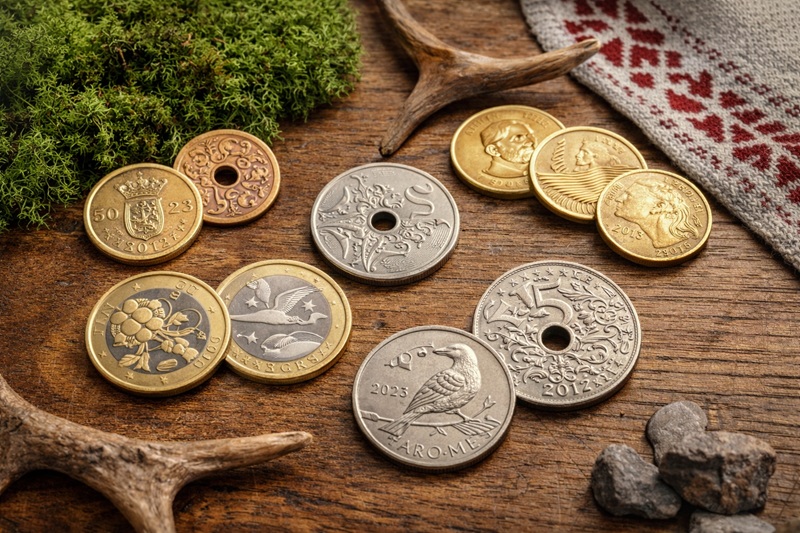
Denmark’s circulation coins are among the most recognizable examples. The 1-, 2-, and 5-kroner coins feature a central hole—an ancient design solution revived for modern use. Historically, holed coins allowed coins to be strung together; today, they help users distinguish denominations instantly by touch.
Inclusive Design in Everyday Currency
Scandinavian coins are intentionally designed for accessibility:
- Distinct sizes and weights reduce confusion
- Edge variations aid tactile recognition
- Holes and textures assist visually impaired users
From an EEAT perspective, this emphasis on inclusivity reinforces trust and authority in currency design. Coins are not just for collectors; they are tools meant to work for everyone.
Materials That Reflect Sustainability and Science
One of the most influential Scandinavian contributions to global coinage is Nordic Gold, a nickel-free alloy developed in Finland. Composed primarily of copper, aluminum, zinc, and tin, Nordic Gold offers several advantages:
- Reduced allergic reactions
- Improved durability
- Lower long-term minting costs
Today, Nordic Gold is used in euro coinage across the European Union, making Finland’s metallurgical innovation a quiet but powerful legacy in modern numismatics.
For investors, material choice matters. Coins made from stable, cost-efficient alloys are less likely to face redesigns or withdrawals, which supports long-term continuity and collectibility.
Nature as a Defining Motif in Scandinavian Coins
A Visual Language Rooted in Landscape
Nature is central to Nordic identity, and Scandinavian coin design reflects this bond. Rather than elaborate allegorical scenes, designers favor plants, animals, and elemental forces rendered in simplified forms.
Examples include:
- Finland’s flying swans on the 1-euro coin
- Cloudberries and blossoms on the Finnish 2-euro coin
- Sweden’s abstract “Sun, Wind, and Water” series
- Norway’s birds, leaves, and vine motifs
These designs are not decorative filler. They function as cultural shorthand, evoking national landscapes and shared memory.
Bridging History and Modernity
Norwegian coins provide a case study in balancing heritage and innovation. The 1-krone coin’s stylized bird is inspired by medieval wood carvings from the Hylestad Stave Church, while the 5-kroner coin draws from traditional acanthus leaf patterns. Rendered in clean, modern lines, these motifs honor craftsmanship without nostalgia.
Numismatic historians often note that such continuity strengthens a coin’s narrative value—an important factor in long-term collector interest.
Innovation in Modern Scandinavian Coin and Bank Note Design
Redesigning Currency for the 21st Century
Between 2015 and 2017, Sweden and Norway undertook major currency redesigns. Sweden introduced smaller, lighter, nickel-free coins that reduced metal use and transportation costs. Norway followed with a striking bank note redesign featuring pixelated coastal imagery by design firm Snøhetta.
These efforts demonstrated that currency redesign can achieve multiple goals:
- Lower environmental impact
- Improved accessibility
- Strong national branding
From a market standpoint, first-issue coins from redesigned series often see heightened collector attention, especially in high-grade condition.
Democratic Design and Social Responsibility
Coins for the Many, Not the Few
The concept of “democratic design” underpins much of Scandinavian culture. Popularized globally by brands like IKEA, it emphasizes five principles: form, function, quality, sustainability, and affordability.
Scandinavian numismatics reflect these same values:
- Coins are durable and cost-effective
- Designs are legible and inclusive
- National symbols foster shared identity
Rather than signaling wealth or status, Nordic coins communicate trust, equality, and continuity. This philosophical grounding adds intangible value that collectors increasingly appreciate.
Collectibility and Investment Considerations
Are Scandinavian Coins Good Investments?
From an investment perspective, Scandinavian coins occupy a middle ground between bullion-driven markets and highly speculative modern commemoratives.
Pros
- Strong issuing authorities
- Consistent design philosophy
- High-quality minting standards
Cons
- Generally high mintages
- Modest short-term price appreciation
Historical data from European auction records suggests that uncirculated sets, first-year issues, and commemorative releases from Nordic mints tend to outperform standard circulation coins over 10–20 year horizons.
Comparison: Key Scandinavian Coin Design Traits
| Country | Design Focus | Notable Feature |
|---|---|---|
| Denmark | Function & tactility | Holed coins |
| Sweden | Minimalism & abstraction | Sun, Wind, Water motifs |
| Finland | Nature & innovation | Nordic Gold alloy |
| Norway | Heritage & modernity | Stylized medieval motifs |
Expert Perspective
As one Scandinavian design historian has observed, “Nordic objects are quiet by design—but their influence is loud over time.” In numismatics, this quiet confidence translates into coins that age gracefully, both culturally and financially.
FAQ: Scandinavian Coin Design
Why do Danish coins have holes?
They improve tactile identification and reference historical coinage.
What is Nordic Gold?
A nickel-free alloy developed in Finland, now widely used in euro coins.
Are Scandinavian coins rare?
Most circulation coins are common, but certain commemoratives and early issues are collectible.
Do minimalist designs hurt collectibility?
No—clarity and symbolism often enhance long-term appeal.
Are Nordic coins still used heavily despite digital payments?
Yes, though usage is declining, coins remain essential for inclusivity.
TL;DR
Scandinavian coin design blends minimalism, functionality, nature, and social responsibility. These principles make Nordic coins culturally significant and quietly collectible.
Conclusion: Small Objects, Enduring Values
Scandinavian coin design proves that even the smallest objects can carry big ideas. Rooted in minimalism, shaped by nature, and guided by democratic values, Nordic coins reflect a design philosophy that transcends trends. For collectors and investors alike, these understated pieces of metal offer more than face value—they offer a lasting lesson in how thoughtful design can serve society, one coin at a time.