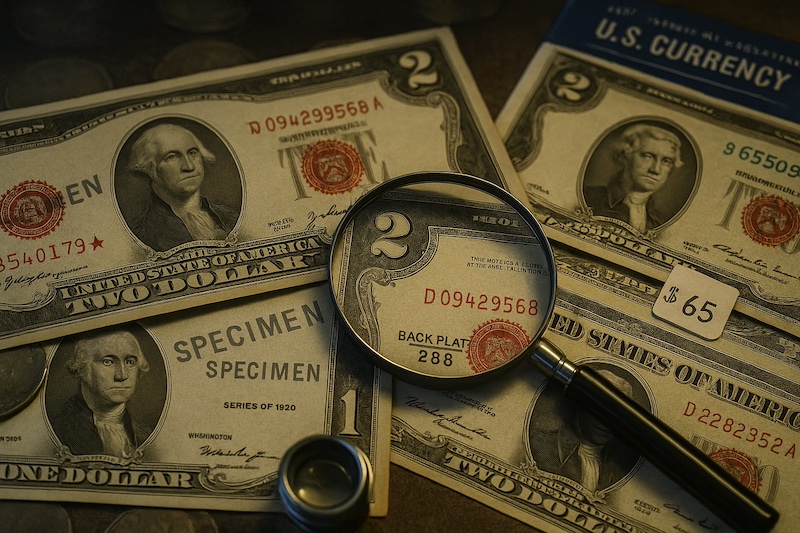
If you enjoy U.S. paper money with character—and genuine challenge—few niches deliver like $1 and $2 Red Seals. On the $1 side, there’s exactly one small-size red seal type: the Series of 1928 United States Note. On the $2 side, an entire decade-spanning family from 1928 through 1963—with stars, mules, and plate-number diagnostics—rewards patience and sharp eyes. Get this segment right and you’ll own pieces that seasoned specialists still hunt.
TL;DR
- For small-size notes, the only red-seal $1 is the 1928 United States Note; star-note replacements are exceptionally scarce and expensive in top grade.
- $2 red seals span 1928 (and sub-series A–G), then 1953 (A–C) and 1963—before switching to green seals in 1976; mule varieties and star notes provide the big money.
- The 1928B $2 star is the super-key; fewer than a dozen are confirmed.
- Classic mule diagnostics on 1928C/1928D $2s rely on plate numbers and macro/micro “back” differences.
- “Red seals” are United States Notes (Legal Tender), an older class of U.S. currency now discontinued but historically redeemable—distinct from Federal Reserve Notes.
Why $1 and $2 Red Seals Matter Now
Red seals combine broad recognition with true scarcity at the variety level. The market also benefits from rich documentation: decades of dealer research, specialist articles, and third-party grading archives make it possible to learn fast and buy better. Add to that a strong pipeline of new collectors intrigued by “the red-seal look,” and you have a segment where knowledge compounds into value.
Historically, United States Notes (Legal Tender) carried the red Treasury seal and serials; they coexisted with other classes like Silver Certificates and, later, Federal Reserve Notes. Though the government stopped issuing USNs long ago, the red seal remains a powerful visual cue—and a collecting magnet.
$1 and $2 Red Seals: A Quick Historical Primer
- Small-size era begins (1928): The United States downsized currency. In this new size, only the 1928 $1 was printed as a red-seal United States Note—with an optional star for replacements.
- $2 red seals proliferate: Starting in 1928 and running through 1963, $2 USNs were regularly issued (then green-seal $2s returned in 1976). The 1928 series is where the majority of key varieties live.
- Design tell: On 1928 $2s the red seal sits on the left; on 1953/1963 $2s it moves to the right—an easy way for beginners to sort piles fast.
“The single-type 1928 $1 red seal is the anchor of any small-size USN set—then the real fun starts with the 1928 two-dollar sub-series,” as one veteran large-show dealer likes to say.
Primary Focus: The 1928 Red-Seal $1 United States Note
What makes it special
- One-year type in small-size red-seal $1s.
- Star notes are notoriously rare; even circulated stars command real money, while high-grade stars are trophy pieces.
Visual/wording cues
- Washington portrait; red seal and serials; classic “United States Note” and legal-tender clause verbiage—distinct from later FRNs.
Collecting tip: If a raw example looks great, slow down—hairlines and minor handling can knock a Prooflike face into mid-grade at certification. Invest in good light and magnification before you buy.
The $2 Red Seals (1928–1963): Where Keys Hide
The checklist, simplified
- 1928: Series 1928, 1928A, 1928B, 1928C, 1928D, 1928E, 1928F, 1928G
- 1953: Series 1953, 1953A, 1953B, 1953C
- 1963: Series 1963, 1963A (red seals end here; 1976 resumes $2 with green seal)
The super-key: 1928B $2 star
When collectors say “holy grail” in this set, they mean the 1928B $2 star. Third-party grading and market coverage indicate fewer than a dozen are known—explaining five-figure pricing when any attractive example surfaces.
Mule varieties: 1928C and 1928D
“Mules” pair an older back with a newer face (or vice versa), producing varieties identifiable by plate sizes/numbers. For $2s, specialists watch the macro vs. micro back and specific number ranges; research shows the rarest 1928C mules may number single digits known, with production windows clustered in late 1939–early 1940.
How to Identify 1928C/1928D $2 Mules (In the Field)
- Plate numbers matter. Mule diagnostics rely on back plate size and specific ranges used during narrow production windows. A widely cited specialist study documents that 1928C mules combine micro face with macro back, with printing spikes Aug. 22–Sept. 7, 1939 and Jan. 22–Feb. 12, 1940.
- Left vs. right seal helps series sorting (1928 left; 1953/1963 right) but doesn’t prove a mule. You must read the plates.
- Bring a loupe and a short reference list of the critical ranges; a quick glance can miss a five-figure note sitting in a dealer’s binder.
For broader plate-number orientation and note anatomy, the U.S. Currency Education Program’s identifier page is a handy refresher.
Market Snapshot: What’s Hot (and Why)
- High-grade 1928 $1 stars: Permanent demand due to type scarcity; deep collector base.
- 1928B $2 stars: Ultra-low supply; any appearance draws registry and core collectors alike.
- 1928C/1928D mules: Research-driven buys; the best pieces have provenance back to specialist literature or old-time collections.
- Original surfaces: Natural paper, no pressing—essential for premium prices.
$1 and $2 Red Seals vs. Later $2 Issues: A Quick Comparison
| Attribute | 1928 $2 Red Seal | 1953/1963 $2 Red Seal | 1976+ $2 Green Seal (FRN) |
|---|---|---|---|
| Seal color | Red | Red | Green |
| Seal position | Left | Right | Right |
| Note class | United States Note (Legal Tender) | United States Note (Legal Tender) | Federal Reserve Note |
| Variety chase | Heavy (stars, mules, plates) | Moderate (stars, some errors) | Light–moderate (stars/fancy SNs/errors) |
| Broad availability | Scarcer | Common–available | Common |
| References: specialist dealer guides and Numista entries; BEP/education resources |
Building a Collection: Strategy by Budget
Entry ($50–$500 per note)
- Target: Attractive 1953/1963 $2 red seals in Choice AU/Unc; a decent 1928 $2 common series in VF–XF; a non-star 1928 $1 in Fine–VF.
- Goal: Learn grading and paper originality; get comfortable reading plate numbers.
Intermediate ($500–$5,000)
- Target: High-grade 1928 $1 (non-star) with eye appeal; better 1928 $2 sub-series; a starter mule verified via plates; entry-level star notes in 1953/1963.
- Goal: Add at least one documented variety with literature or TPG attributions.
Advanced ($5,000+)
- Target: 1928 $1 star in choice grade; 1928C/1928D mule with strong provenance; if lightning strikes, a 1928B $2 star opportunity.
- Goal: Curate a set with narrative—type, stars, and at least one mule.
Authentication, Grading, and Storage
- Third-party grading (TPG): For five-figure material (star keys, mules), TPG encapsulation is the norm. It standardizes condition and discloses net grades for restorations.
- Originality first: Pressing/cleaning kills premiums. Buy the note, not the holder.
- Storage: Mylar (no PVC) sleeves or TPG holders; stable humidity; avoid direct light.
- Documentation: Keep auction tags, old collection notes, and literature references with the note—provenance matters most on varieties.
Common Myths—Corrected
- “All red seals are rare.” No. Many 1953/1963 $2s are inexpensive in circulated grades. Rarity concentrates in 1928 sub-series, star replacements, and mules.
- “Mules are easy to spot without tools.” Rarely. You must read plates and understand ranges/time windows.
- “The Treasury still prints red seals.” No. United States Notes are discontinued issues; the red seal is a historical artifact of that class of currency.
Case Study: The 1928B $2 Star
Certification news notes that 1928B $2 star notes are “particularly rare,” with fewer than a dozen examples known. When a top-grade specimen surfaced, it headlined the specialist press—evidence of the series’ thin surviving population and the intensity of demand.
Spotting Opportunity at Shows and in Dealer Stock
- Small shows can still hide value: dealers may lump 1928 $2s without variety sort.
- Bring a loupe and a plate-number crib sheet—especially for 1928C/1928D mules.
- Ask to see stars separately. Many dealers pre-sort, but stars occasionally languish in “back stock.”
- Check edges and corners. 20th-century superstition led some to tear corners off $2s as “bad luck”—fatal to value.
$1 and $2 Red Seals: Pros and Cons
Pros
- Deep history (United States Notes) and strong visual appeal (red seal/serials).
- A mix of accessible types and true rarities (1928B $2 star, scarce mules).
- Excellent literature trail, enabling informed purchasing.
Cons / Risks
- Counterfeits/alterations: Watch for re-inked serials, removed stains/pressing.
- Variety complexity: Plate diagnostics require study; mistakes are costly.
- Thin liquidity at the very top: Keys bring big money, but buyer pools are specialized.
Expert Tips (Fast Wins)
- Master the left/right seal cue to sort 1928 vs. 1953/1963 $2s instantly.
- Learn the mule windows (late 1939–early 1940) and carry a short plate-number list.
- Prioritize originality over holder labels; original paper commands premiums across all grades.
- Document everything—especially for stars and mules.
- Network with specialists; many keys trade quietly before public auction.
FAQs
Are $1 and $2 red seals still legal tender?
Yes for class (United States Notes historically remained redeemable), but they’re no longer issued. They circulate mostly as collectibles.
What’s the single best starter note?
A nice 1953 or 1963 $2 red seal in Choice AU/Unc—affordable and eye-appealing. Then move to a 1928 $2 and finally a 1928 $1 (non-star) as budget allows.
How rare is the 1928B $2 star?
Extremely—specialist sources cite fewer than a dozen known.
What exactly is a “mule”?
A note printed with an older back plate paired to a newer face plate (or vice versa). On 1928 $2s, diagnostics hinge on macro/micro backs and narrow production windows in 1939–1940.
Where can I study plate positions and numbers?
Start with the U.S. Currency Education Program overview; then consult specialized mule research and series-specific articles.
Conclusion & Call to Action
The $1 and $2 Red Seals niche offers the best of both worlds: accessible entry notes with iconic looks—and advanced targets that demand scholarship, patience, and sharp buying discipline. Begin with clean 1953/1963 $2s, graduate to a nice 1928 $2, then anchor your set with the 1928 $1 red seal and, if fortune smiles, a star or mule. Study plate numbers, insist on original paper, and document provenance. Do that consistently and you’ll build a red-seal cabinet that impresses dealers and delights fellow collectors—today and at the next big show.
Meta Description
$1 and $2 Red Seals explained: keys, stars, and mules. Learn the 1928 $1 red seal, rare 1928B $2 star, mule diagnostics, pricing tips, and how to buy smart.